Aluminium Profiles in Modular Furniture: Insights from Manufacturers & Suppliers


Aluminium Profiles in Modular Furniture: Insights from Manufacturers & Suppliers
Modern modular furniture relies on precision, consistency, and adaptability. At the heart of this evolution are aluminium profiles—engineered components that provide structural support, dimensional accuracy, and design flexibility across modular kitchens, wardrobes, and storage systems.
For aluminium profiles manufacturers, suppliers, OEM partners, and large distributors in India, aluminium profiles are not decorative trims. They are foundational furniture hardware elements that define how modular furniture is built, aligned, and integrated with other hardware systems. This guide examines aluminium profiles from a manufacturer–supplier perspective, focusing on material advantages, system compatibility, and long-term performance rather than individual product promotion.
Why Aluminium Profiles Matter in Modular Systems
Aluminium profiles are widely adopted in modular furniture due to their strength-to-weight ratio, corrosion resistance, and dimensional stability. These properties make aluminium particularly suitable for modular construction, where accuracy and repeatability are essential.
From a systems viewpoint, aluminium profiles enable:
-
Precise alignment of cabinets, frames, and panels
-
Structural rigidity without excessive weight
-
Compatibility with multiple hardware components
In Indian usage conditions—where furniture must withstand frequent use, humidity, and temperature variation—aluminium profiles offer a reliable structural solution.
Aluminium Profiles in Modular Kitchen Frameworks
Modular kitchens demand high structural accuracy to ensure smooth operation of drawers, pull-outs, and sliding shutters. Aluminium profiles are commonly used in cabinet frameworks, shutter frames, and internal supports.
System-Level Benefits
-
Accurate mounting surfaces for drawer channels and telescopic channels
-
Stable alignment for pull-out kitchen drawers and pantry systems
-
Resistance to moisture-related deformation compared to wood-based structures
Manufacturers design aluminium profiles to integrate seamlessly with modular kitchen dimensions, enabling consistent installation across projects.
Integration with Drawer Systems and Telescopic Channels
Drawer systems depend heavily on structural precision. Even minor misalignment can affect drawer movement and load performance.
Aluminium profiles support drawer systems by:
-
Providing straight, rigid mounting planes for drawer channels
-
Maintaining dimensional accuracy over long spans
-
Supporting heavy loads in wide drawers and pull-out units
When combined with telescopic channels, aluminium profiles help ensure smooth, repeatable drawer operation in kitchens and wardrobes alike.
Supporting Sliding Systems and Wardrobe Applications
Sliding systems, particularly in modular wardrobes, place high demands on frame stability and alignment. Aluminium profiles are widely used in sliding door frames, tracks, and structural members.
Key considerations include:
-
Load-bearing capability for tall and wide sliding panels
-
Precision extrusion for straight, low-friction movement
-
Long-term alignment under repeated opening and closing cycles
Sliding system manufacturers and suppliers rely on consistent aluminium profile specifications to deliver reliable wardrobe solutions across residential and project installations.
Compatibility with Stainless Steel Accessories and Storage Systems
Aluminium profiles do not operate in isolation. They form part of a broader hardware ecosystem that includes stainless steel kitchen accessories, organisers, and storage baskets.
System compatibility ensures that:
-
Stainless steel kitchen storage baskets and pull-outs mount accurately
-
Kitchen organisers and corner units operate without interference
-
Visual and functional consistency is maintained across hardware components
Manufacturers and suppliers focus on standardized fixing points and tolerances to enable smooth integration between aluminium and stainless steel systems.
Role in Modular Kitchen Storage Baskets and Corner Units
Modular kitchen storage baskets and corner units often involve complex movement and uneven load distribution. Aluminium profiles contribute structural stability to these systems by supporting frames and mounting hardware.
Their use helps:
-
Maintain alignment of corner mechanisms
-
Prevent long-term sagging or deformation
-
Improve overall load distribution across the cabinet structure
This structural reliability is essential for high-usage kitchen environments.
Pull-Out Mechanisms and Pantry Systems
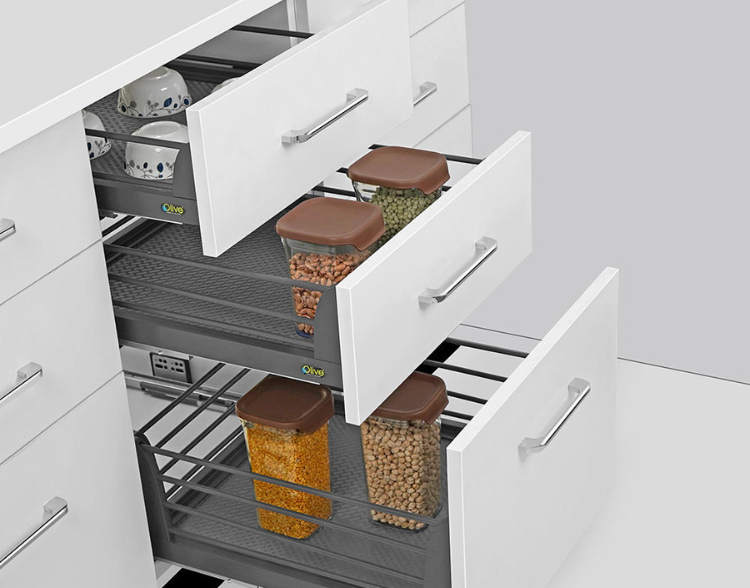
Pull-out kitchen drawers and soft-close pantry pull-out mechanisms rely on precise alignment between moving components and fixed structures. Aluminium profiles provide the accuracy needed for these mechanisms to function correctly.
From a manufacturing perspective, aluminium profiles enable:
-
Consistent installation of tall pantry units
-
Smooth operation of soft-close and damping systems
-
Reduced installation variability across large projects
Aluminium Profiles Beyond Kitchens: Bathrooms and Utility Spaces
Aluminium profiles are increasingly used in bathroom vanities, utility cabinets, and storage units. In these spaces, resistance to moisture and corrosion is particularly important.
When sourced as part of coordinated hardware ranges—including bathroom accessory fittings—aluminium profiles help maintain consistency in quality, finish, and performance across the home.
Manufacturing Consistency and Supply Reliability in India
India’s modular furniture industry operates at scale, serving residential, commercial, and institutional projects. Aluminium profiles suppliers support this ecosystem by ensuring:
-
Uniform extrusion quality across production batches
-
Availability of standard and project-specific profile sizes
-
Consistent surface finishes and dimensional tolerances
Supply reliability allows manufacturers, dealers, and contractors to meet project timelines and quality expectations.
Conclusion: Aluminium Profiles as Enablers of Modular Precision
Aluminium profiles are essential to the structure, accuracy, and performance of modern modular furniture. Their role extends beyond framing to enabling smooth drawer movement, reliable sliding systems, and integrated storage solutions.
By approaching aluminium profiles through a system-integration lens, manufacturers and suppliers contribute to durable, precise, and scalable modular kitchens and wardrobes across India.
As modular furniture continues to evolve, aluminium profiles will remain a key link between material science, engineering discipline, and everyday functionality.
Drawer.png)