Stainless Steel Kitchen Accessories Supplier Guide: Building Modular Storage Systems for Modern Indian Homes

stainless-steel-kitchen-accessories.jpg)
Stainless Steel Kitchen Accessories Supplier Guide: Building Modular Storage Systems for Modern Indian Homes
Modern Indian homes are increasingly shaped by modular thinking—spaces designed for efficiency, adaptability, and long-term use. At the core of this shift lies stainless steel. Beyond surface aesthetics, stainless steel kitchen accessories and storage systems form the structural backbone of modular kitchens, wardrobes, and integrated home storage solutions. For manufacturers, suppliers, architects, and large project contractors, understanding how these systems work together is critical to delivering performance-driven interiors.
This guide explores how a stainless steel kitchen accessories supplier contributes to the larger modular ecosystem. Rather than focusing on individual products, it looks at system compatibility, manufacturing quality, material performance, and supply reliability—key factors that define successful modular installations across India.
Stainless Steel as a System Material, Not Just a Finish
Stainless steel is widely used in modular furniture because of its corrosion resistance, structural strength, and hygiene benefits. In Indian conditions—where humidity, temperature variation, and heavy daily usage are common—these properties are not optional; they are foundational.
For modular kitchens and wardrobes, stainless steel performs three critical roles:
-
Load-bearing strength for baskets, drawers, and pull-out systems
-
Dimensional stability for smooth operation of sliding and telescopic mechanisms
-
Corrosion resistance for long service life in kitchens and bathrooms
A supplier’s role is to ensure that material grades, thicknesses, and surface treatments remain consistent across product categories, allowing different systems to function together without compromise.
Stainless Steel Kitchen Accessories & Organisers: The Core Layer
Stainless steel kitchen accessories are often the most visible components of a modular kitchen, but their true value lies in performance. These include kitchen organisers, plate racks, thali baskets, bottle pull-outs, and under-sink storage systems.
From a systems perspective, these accessories must:
-
Fit standardized cabinet widths used by modular kitchen manufacturers
-
Support defined load capacities without deformation
-
Maintain smooth movement even after years of use
Suppliers who understand modular integration design accessories around cabinet modules, not as standalone items. This ensures that accessories work seamlessly with drawer channels, corner units, and pantry systems.
Modular Kitchen Storage Baskets & Corner Units: Solving Space Geometry
Indian kitchens often deal with compact layouts and corner-heavy designs. Modular kitchen storage baskets and corner units are engineered solutions to these spatial challenges.
Key System Considerations
-
Corner units such as carousel or swing mechanisms rely on precision-balanced stainless steel frames
-
Pull-out baskets must align perfectly with telescopic channels and soft-close systems
-
Wire thickness and welding quality directly affect load distribution and long-term stability
A reliable stainless steel kitchen accessories supplier ensures that baskets and corner systems are designed as part of a unified hardware ecosystem, not as isolated products.
Drawer Systems & Telescopic Channels: Precision in Motion
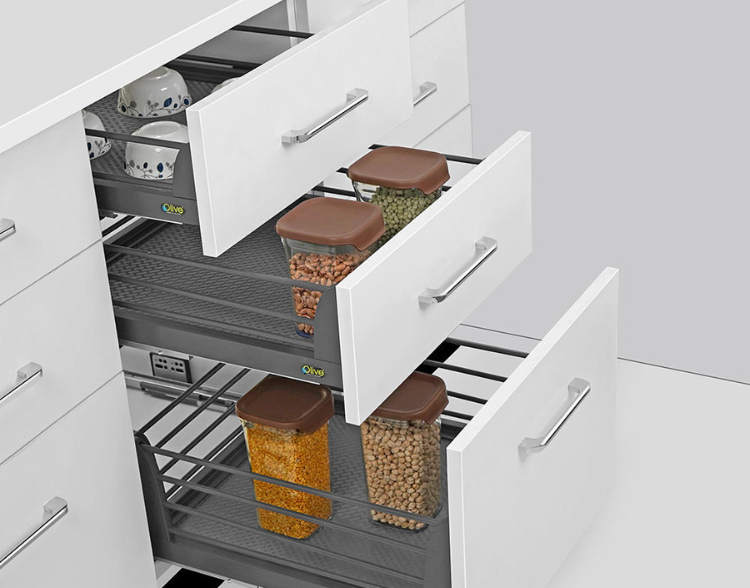
Drawer systems are among the most mechanically demanding elements in modular furniture. Whether used in kitchens, wardrobes, or utility units, drawers must perform consistently under repeated load cycles.
Components That Work Together
-
Drawer channels and telescopic channels determine smoothness, extension length, and load rating
-
Pull-out kitchen drawers rely on accurate alignment between stainless steel frames and channel systems
-
Soft-close mechanisms require tight tolerance control during manufacturing
Suppliers play a critical role in ensuring compatibility between stainless steel drawer bodies and channel systems—especially when products are sourced or assembled at scale for large projects.
Pantry Pull-Out Systems & Multi-Purpose Organisers
Soft-close pantry pull-out systems represent the evolution of vertical storage in Indian kitchens. These systems combine height, weight, and movement—placing high demands on material quality.
From a supplier standpoint, performance depends on:
-
High-grade stainless steel frames that resist twisting
-
Even load distribution across multiple shelves
-
Channel systems tested for vertical stability
Multi-purpose kitchen organisers extend these principles to utility spaces, ensuring that modular thinking flows beyond the kitchen into the entire home.
Wardrobe Systems & Modular Sliding Solutions
Stainless steel is no longer limited to kitchens. Wardrobe systems increasingly depend on stainless steel and aluminium-based hardware for durability and smooth operation.
System-Level Integration
-
Modular wardrobe sliding systems rely on stainless steel tracks and rollers
-
Internal organisers use baskets and pull-out trays similar to kitchen systems
-
Sliding systems must remain aligned over long spans and frequent use
Suppliers who serve both kitchen and wardrobe manufacturers can standardize components, simplifying sourcing and ensuring consistent performance across living spaces.
Aluminium Profiles in Modular Furniture Construction
While stainless steel provides strength and durability, aluminium profiles contribute to structural framing and visual refinement in modular furniture.
In integrated systems:
-
Aluminium profiles define cabinet edges, frames, and sliding panels
-
Stainless steel accessories attach to aluminium structures through standardized fixing systems
This cross-material compatibility is a key responsibility for manufacturers and suppliers, particularly in large-scale residential or commercial projects.
Bathroom Accessory Fittings: Extending the Hardware Ecosystem
Bathroom accessory fittings often complete the modular home hardware offering. Though functionally different, they share material and manufacturing principles with kitchen and wardrobe systems.
Stainless steel bathroom accessories benefit from:
-
Corrosion resistance in high-moisture environments
-
Structural strength for wall-mounted applications
-
Visual consistency with kitchen and wardrobe hardware
For distributors and project contractors, sourcing bathroom fittings from the same supplier ecosystem improves consistency and simplifies quality control.
Manufacturing Quality & Supply Reliability in the Indian Context
India’s modular furniture market operates at scale, serving residential, commercial, and institutional projects. This makes supply reliability as important as product design.
A knowledge-driven stainless steel kitchen accessories supplier focuses on:
-
Controlled manufacturing processes for repeatable quality
-
Testing for load capacity, corrosion resistance, and cycle life
-
Consistent specifications across batches and product lines
-
Reliable distribution to support project timelines
For architects, OEM partners, and large dealers, this reliability reduces on-site issues and long-term maintenance concerns.
Systems Thinking: The Real Value of a Stainless Steel Supplier
The true value of a stainless steel kitchen accessories supplier lies in systems thinking. Modular kitchens, wardrobes, and storage solutions succeed when every component—from baskets and drawers to sliding systems and profiles—works together as a unified whole.
By focusing on material performance, compatibility, and long-term durability, suppliers support not just individual installations, but the evolution of modular living in India.
Conclusion
Stainless steel kitchen accessories are no longer just add-ons; they are integral to the structure and performance of modern modular homes. For manufacturers, designers, and project stakeholders, understanding how these systems are built—and how suppliers ensure their reliability—leads to better design decisions and more durable outcomes.
As modular living continues to expand across India, stainless steel will remain a foundational material, connecting kitchens, wardrobes, and storage systems into cohesive, high-performance environments.
Drawer.png)